Updated October 2026. This post replaces my original July 2026 SB 9 explainer with the SB 450 changes, the latest court ruling, and the AB 956 comparison investors are now asking about.
SB 9 lets you put two homes on most single-family lots in California, or split the lot into two parcels, with no public hearing and no discretionary review. If the project meets the city’s objective standards, the city has to approve it.
For an investor, that means a single-family lot can become two to four legal units, and sometimes two separately sellable parcels. But SB 9 has more rules than the headlines suggest, and the law changed in 2025. Here’s the current version.
The short version
- What it allows: a two-unit development on one lot, an urban lot split into two parcels, or both (up to four units total).
- Approval: ministerial. No hearing, no neighbor appeals, and since 2025, a 60-day decision deadline.
- Biggest catch: a lot split requires you to sign an affidavit to live in one unit for three years.
- Still valid? Yes. The 2024 charter-city ruling was reversed in November 2025. I cover the full timeline in Is SB 9 Still Valid in 2026?
What SB 9 lets you build
SB 9 took effect January 1, 2022. It added two tools to state law:
| Tool | What you get | Owner-occupancy required? | Separate parcels? |
|---|---|---|---|
| Two-unit development | Two primary homes on one lot (existing house + new unit, or two new units) | No | No |
| Urban lot split | Two parcels from one lot, up to two units on each | Yes, 3-year affidavit | Yes |
| Both combined | Up to four units across two parcels | Yes | Yes |
Cities can’t use their standards to block a unit of at least 800 square feet, and they can’t require side and rear setbacks greater than four feet. Parking is capped at one space per unit, and none can be required within a half mile of high-quality transit or within one block of a car-share vehicle.
The state’s HCD SB 9 fact sheet is the official summary if you want to read the rules straight from the source.
Who qualifies
The lot must be in a single-family residential zone and inside an urbanized area or urban cluster. Then it has to clear these filters:
- Not historic. No historic districts or landmark properties.
- Not in a very high fire hazard severity zone, unless the city has adopted fire mitigation standards the project meets.
- Not in a special flood hazard area or floodway, unless it meets FEMA and local floodplain requirements.
- Not on prime farmland, wetlands, or habitat for protected species.
- No tenant history in the last three years. SB 9 can’t be used to demolish or alter rent-controlled or affordable units, or any unit a tenant occupied in the past three years. I break down how this works in SB 9’s built-in tenant protection.
For a lot split, add these:
- The original lot must be at least 2,400 sq ft.
- Each new parcel must be at least 1,200 sq ft and 40% to 60% of the original.
- The lot can’t have been created by a prior SB 9 split.
- You (or someone acting with you) can’t split an adjacent lot too.
- You sign the three-year owner-occupancy affidavit.
In practice, the tenant rule and the occupancy affidavit knock out more investor deals than lot size does. Ask about tenant history before you write an offer.
What changed in 2025: SB 450
SB 450 took effect January 1, 2025, and made SB 9 stronger for owners. The Burke, Williams & Sorensen summary covers the details. The changes that matter to investors:
| SB 450 change | What it means for you |
|---|---|
| 60-day deadline | A complete application must be approved or denied within 60 days, or it’s deemed approved |
| Uniform standards only | Cities can’t apply standards to SB 9 projects that they don’t apply to everything else in the zone |
| Lot split standards narrowed | For splits, cities can only apply standards about parcel design and improvements |
| Written denials | A denial must list every deficiency and how to fix it |
| 25% wall rule removed | The old rule tying demolition of more than 25% of exterior walls to tenant history is gone (the three-year tenant protection on demolition still applies) |
The 60-day clock is the big one. Before SB 450, some cities let SB 9 applications sit for months.
Where the court fight stands
In April 2024, an LA Superior Court judge ruled SB 9 unconstitutional as applied to five charter cities: Carson, Del Mar, Redondo Beach, Torrance, and Whittier. On November 12, 2025, the Court of Appeal sent that ruling back to the trial court, holding that SB 450 was an intervening change in law. A separate challenge by general law cities, including Lakewood, already failed.
As of October 2026, SB 9 applies in every city I work in, charter cities included. The case can still produce a new trial-court ruling, so watch for it, but I wouldn’t plan a purchase around one.
How SB 9 stacks with ADUs
This is where most of the confusion lives.
Without a lot split, you can generally combine a two-unit SB 9 development with ADU rules, depending on the city. Some cities allow the full four units on one lot, and some don’t.
With a lot split, each new parcel is capped at two units total, and that count includes ADUs and JADUs. Most people read “four units” and assume you can put a duplex plus two ADUs on each half. You can’t. I explain it in the two-unit maximum per parcel that most people misread, and the full overlap is in how SB 9 works with ADUs.
Two regional differences to know:
- City of Los Angeles: ZA Memo 143 changes the ADU math on SB 9 lots. See why SB 9 lots in LA city are a different beast.
- Unincorporated LA County: the 2026 draft amendment targets ADUs on lot-split parcels. See what LA County’s draft means for lot splits.
The lot split process, step by step
- Confirm eligibility. Zoning, fire, flood, historic status, and tenant history. I pull the parcel data and the city’s SB 9 checklist before you’re in contract.
- Hire a licensed surveyor to prepare the tentative parcel map.
- Submit to the city. Review is ministerial and limited to objective standards. Under SB 450, the city has 60 days on a complete application.
- Record the parcel map with the county after approval. Now you have two legal parcels with two APNs.
- Pull building permits for any new construction.
City rules vary a lot inside these steps. If you’re targeting a specific city, my Garden Grove SB 9 eligibility checklist shows what a city-level checklist looks like.
What an SB 9 project costs
These are planning ranges I see on Orange County and LA County projects in 2026. Get real quotes before you commit.
| Cost item | Typical range |
|---|---|
| Survey, parcel map, and city/county fees (lot split only) | $25,000 to $60,000 |
| Utility separation for a split (separate meters, laterals) | $15,000 to $50,000+ |
| Converting existing space into a unit | Lowest cost, tightest layout limits |
| New attached unit | Mid-range |
| New detached unit (800 sq ft at roughly $350 to $450 per sq ft) | $280,000 to $360,000 |
| Full SB 9 duplex project, all-in | $150,000 to $450,000+ |
Build cost per square foot drops as the unit gets bigger, because kitchens and bathrooms are fixed costs. That’s why I usually push investors toward the larger unit when the lot allows it. The rent difference shows up clearly in my Buena Park 500 vs. 800 sq ft comparison.
How financing works
SB 9 changes your loan in ways an ADU doesn’t:
- A two-unit development turns the property into a 2-unit for lending. That can change the down payment, rate, and how lenders count rent.
- A lot split means the parcel securing your loan is changing. Your lender has to agree to release or restructure, and that conversation should happen before you file the parcel map. I walk through the options in SB 9 lot split financing.
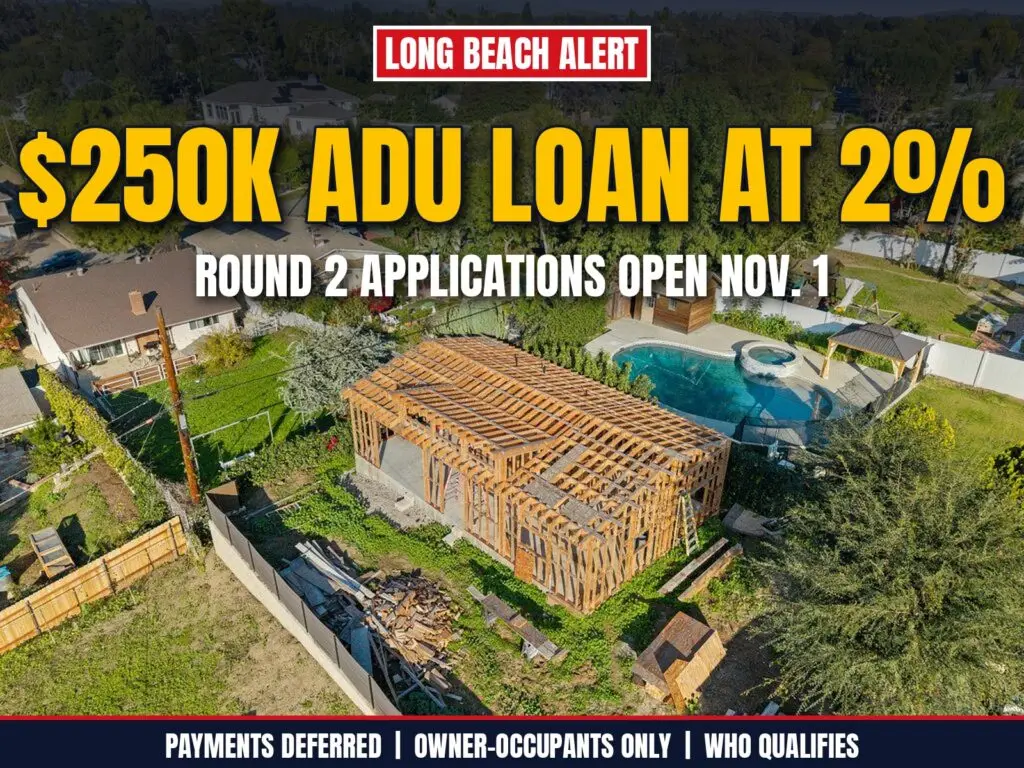
- Construction money usually comes from cash, a HELOC, or a construction loan. Each one has trade-offs at today’s rates, and the right one depends on how much equity you have and how long you plan to hold.
When SB 9 makes sense, and when two ADUs win
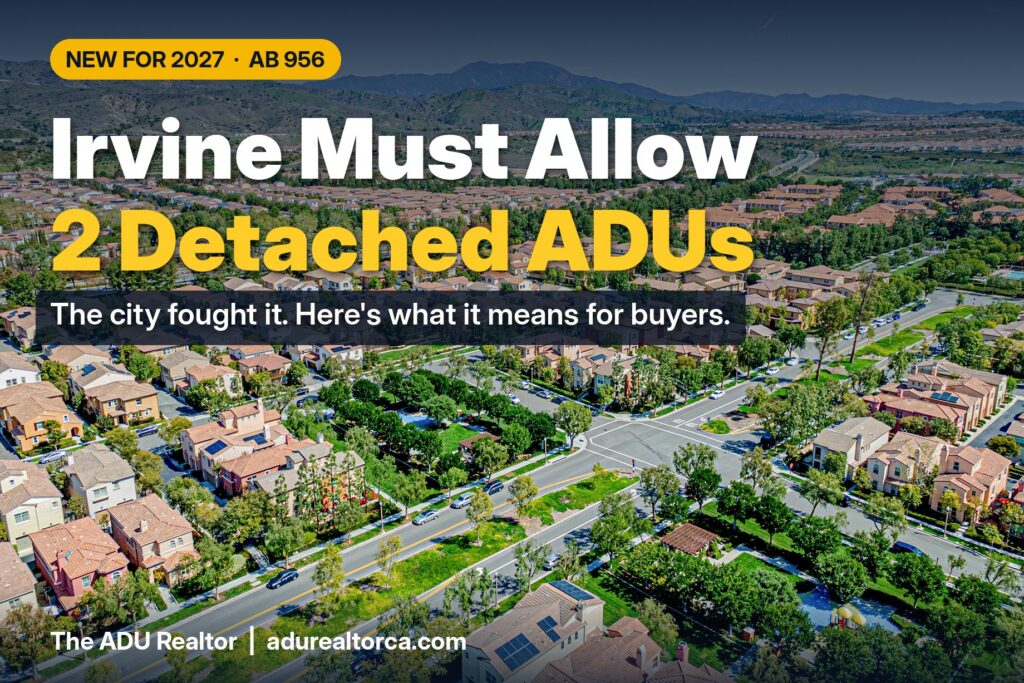
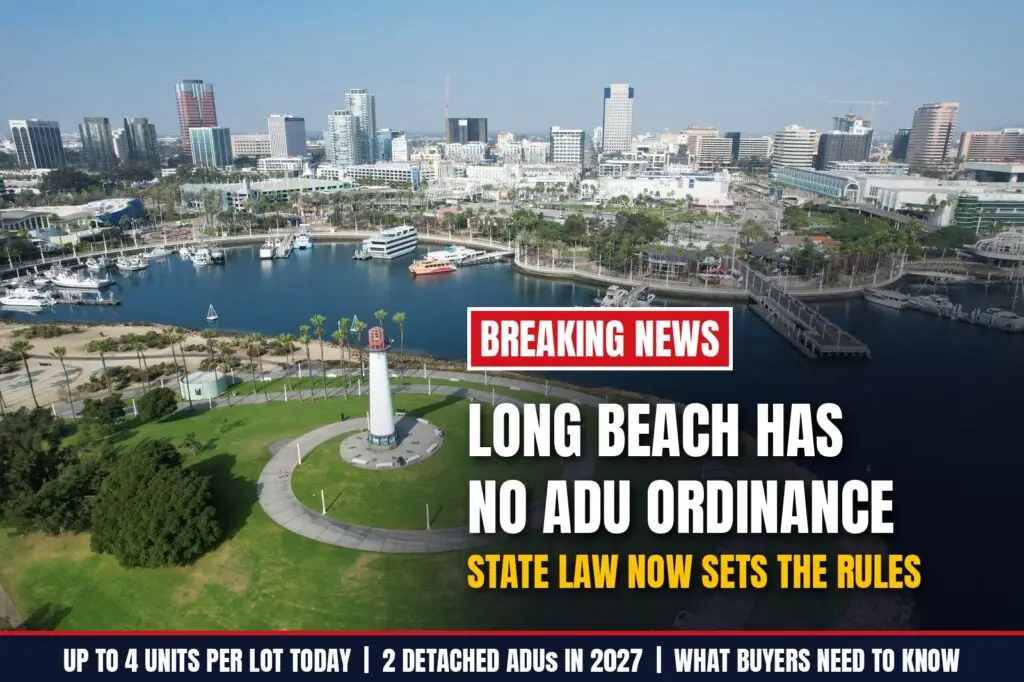
Starting January 1, 2027, AB 956 lets many single-family lots add two detached ADUs, plus a JADU. That changes the decision for a lot of buy-and-hold investors.
| Your goal | Better path | Why |
|---|---|---|
| Buy and hold for rental income | ADUs (AB 956) | No occupancy affidavit, no parcel map, no lender release |
| Create a parcel you can sell separately | SB 9 lot split | ADUs generally can’t be sold apart from the main house |
| Build a unit bigger than ADU size limits | SB 9 two-unit | SB 9 units aren’t bound by ADU square footage caps |
| You plan to live on the property 3+ years | SB 9 lot split | The affidavit isn’t a burden if you’re moving in anyway |
| Property has tenant history | Usually ADUs | SB 9’s 3-year tenant rule can block demolition |
SB 9 is strongest on larger lots (roughly 6,000 sq ft and up) in cities with strong rents and land values, where a separate parcel is worth real money. On small lots, lots near coverage limits, or properties with recent tenants, the ADU path is usually cleaner.
For a real example, here’s how one investor combined SB 9 and an ADU to collect about $9,000 a month from one Buena Park property.
FAQ
What is SB 9 in simple terms?
SB 9 is a California law that requires cities to approve, without a hearing, two homes on most single-family lots, a split of the lot into two parcels, or both. It took effect January 1, 2022.
Is SB 9 still in effect in 2026?
Yes. It applies statewide, including in charter cities. The 2024 ruling that exempted five charter cities was sent back to the trial court in November 2025.
How many units can I build under SB 9?
Up to two on a lot without a split. With a lot split, up to two per parcel, so four total. ADUs and JADUs count toward the two-unit cap on split parcels.
Do I have to live on the property?
Only for a lot split. You sign an affidavit to live in one unit for three years. A two-unit development without a split has no owner-occupancy requirement under state law.
What’s the minimum lot size for an SB 9 lot split?
The original lot must be at least 2,400 sq ft, and each new parcel must be at least 1,200 sq ft and between 40% and 60% of the original lot.
How long does SB 9 approval take?
Under SB 450, cities must approve or deny a complete application within 60 days, or it’s deemed approved. Surveying, mapping, and recording add time on top of that.
Can I use SB 9 on a property with tenants?
Not if the project would demolish or alter a unit a tenant has occupied in the last three years, or a rent-controlled or affordable unit.
Is SB 9 or two ADUs better for an investor?
For most buy-and-hold investors starting in 2027, two ADUs under AB 956 are simpler. SB 9 wins when you want a separately sellable parcel or a unit larger than ADU size limits.
The bottom line
SB 9 can turn one single-family lot into two to four legal units, and sometimes two parcels, with no hearing and a 60-day approval clock. The law is stronger than it was when it passed, and it survived its biggest court challenge. Your real risks are the lot, the tenant history, the occupancy affidavit, and whether the build cost pencils at today’s rates.
If you’re looking at a property and want to know whether SB 9 or the ADU path makes more money on that specific lot, I’ll run it with you.
👉 Book a buyer ADU consult call to go through your options with Dylan
Prefer to talk now? Call Dylan Serna, ADU Realtor at 714-860-2868.
Dylan Serna | The ADU Realtor | eXp Realty | DRE #02217359
This post is general information, not legal or tax advice. SB 9 rules vary by city, and the charter-city case was remanded for further proceedings. Confirm current rules with the city and a land use attorney before you buy.