Any licensed agent in California can help you buy a house with an ADU, or a house you plan to add one to. Most of them will get you to the closing table. The difference is what happens before you write the offer, and what you know about the deal when you sign.
A typical agent focuses on the house: price, condition, the inspection, and closing on time. An ADU realtor focuses on the whole property as an investment: what the lot can hold, what the second unit will rent for, how you’ll pay to build it, which city rules apply, and whether the numbers work at this price.
Here’s what that difference looks like across 10 parts of an ADU purchase in Orange County and LA County.
ADU Realtor vs. Typical Agent at a Glance
| Part of the deal | Typical agent | ADU realtor |
|---|---|---|
| 1. Focus | Every type of home and buyer | ADU and SB 9 investment properties in addition |
| 2. “ADU potential” | Repeats what the listing says | Checks lot size, access, city, and house-to-lot ratio first |
| 3. Existing ADU permits | Relies on seller disclosures | Pulls permit records and matches them to the unit |
| 4. Rent | A ballpark guess | Rent comps matched to the ADU you’ll have or build |
| 5. Loan qualifying | “Ask your lender” | Knows how lenders count ADU rent and the caps |
| 6. Build financing | Not part of the job | Compares cash, HELOC, and construction loans |
| 7. City selection | Wherever you’re looking | Knows which cities are ADU-friendly and why |
| 8. ADU law | Rarely tracked | Follows AB 956, SB 1117, SB 1196, and SB 9 |
| 9. Rent control | Often not considered | Explains how AB 1482 applies to a new ADU |
| 10. Negotiation | Price and repairs | Uses ADU comps, days on market, and price cuts |
1. Specialization: One Kind of Deal vs. Every Kind of Deal
Typical agent: Sells condos one week, starter homes the next, and maybe a luxury listing after that. Broad experience, but an ADU deal is something they see occasionally.
ADU realtor: ADU and SB 9 investment properties are the whole business. That’s why I go by The ADU Realtor. The same questions come up on every deal (lot, access, rent, build cost, financing, city rules), and repetition is what makes the answers fast and accurate.
What that looks like in practice: here’s how one of my investors now collects about $9,000 a month from a single Buena Park SB 9 + ADU property. Whoever you hire, ask to see a deal like that with real numbers, and check their license on the California DRE public license lookup. Mine is DRE #02217359.
2. Screening for Real ADU Potential
Typical agent: Sends you listings that say “ADU potential” in the remarks.
ADU realtor: Treats “ADU potential” as a claim to verify. California law makes nearly every single-family lot ADU-eligible on paper, but a cramped studio on a 5,000 square foot lot isn’t the same investment as a detached 2-bed on a 7,500 square foot lot. I run four filters before you see a property:
- Lot size: 6,000 square feet is my practical floor for a detached, multi-bedroom ADU.
- Backyard access: a corner lot, detached garage with a side driveway, or RV gate. No access means higher build costs and a less private tenant entrance.
- City: permit speed, pre-approved plans, impact fees, and enough comparable sales to underwrite the deal.
- House-to-lot ratio: a small house on a big lot has room for more than one unit.
Then come the red flags: pools in the buildable area, easements, slopes, and unpermitted additions. Once you’re in contract, the checking keeps going. Here’s how I verify ADU potential during escrow.
3. Verifying Permits on an Existing ADU
Typical agent: Hands you the seller’s disclosures and the inspection report.
ADU realtor: Pulls the permit history from the city and compares it to what’s actually on the lot: square footage, bedroom count, kitchen, and utility setup. If the permits say “garage conversion, 400 sq ft” and you’re looking at a 650 sq ft 2-bed, that’s a conversation we have before your contingencies expire, not after.
An unpermitted unit can cause problems with financing, insurance, appraisal, and resale. California already requires agents on a 1 to 4 unit sale to do a reasonably diligent visual inspection and disclose what it reveals. That’s the legal floor. An ADU realtor goes past it with permit records, the assessor’s record, and a contractor’s eyes on the unit when something doesn’t match.
4. Projecting Rent on the Unit You’ll Have
Typical agent: “It’ll probably rent for around $3,000.”
ADU realtor: Pulls rent comps for units that match the ADU you’d actually have: same bed and bath count, similar size, same type (detached, attached, or garage conversion), and the same part of town. Detached 2-bed and 3-bed ADUs in Orange County commonly rent in the $2,800 to $3,500+ range, but the right number for your lot depends on those details.
This matters more than it looks. Overestimate rent by $500 a month and you’ve overestimated income by $6,000 a year, which flows straight into overpaying for the property. I also track how rented ADU properties actually sell. In my Costa Mesa ADU market update for October 2026, homes with a rented ADU sold fast while overpriced listings sat and took cuts.
5. Knowing How ADU Rent Affects Your Loan
Typical agent: Leaves it to the lender, or assumes the lender counts all the rent.
ADU realtor: Knows the rules before you shop, because they change your budget. Under Fannie Mae’s rental income guidelines for ADUs:
| Rule | What it means for you |
|---|---|
| Property type | One-unit primary residence with an ADU on the same parcel |
| Income cap | ADU rent can’t exceed 30% of your total qualifying income |
| Vacancy factor | The example reduces gross ADU rent by 25% before applying limits |
| Appraisal | Needs a rent schedule (Form 1007) estimating the ADU’s rent |
So a $3,000 ADU rent might count as about $2,250 for qualifying, and only up to the 30% cap. I ran the full math in how much more house an ADU lets you qualify for on a $1.3M Orange County purchase. Lender overlays vary, so confirm the details with yours.
6. Planning How You’ll Pay for the Build
Typical agent: The job ends at closing. How you pay for construction is your problem.
ADU realtor: Helps you plan the build budget before you buy, since it affects how much cash you need and what price makes sense. The three main options:
- Cash: simplest and fastest, with no extra interest. Ties up the most capital.
- HELOC: flexible, with interest only on what you draw. Requires existing equity, and the rate is usually variable.
- ADU construction loan: can be based on the property’s value after the ADU is built. More paperwork, but you can build without a pile of cash on hand.
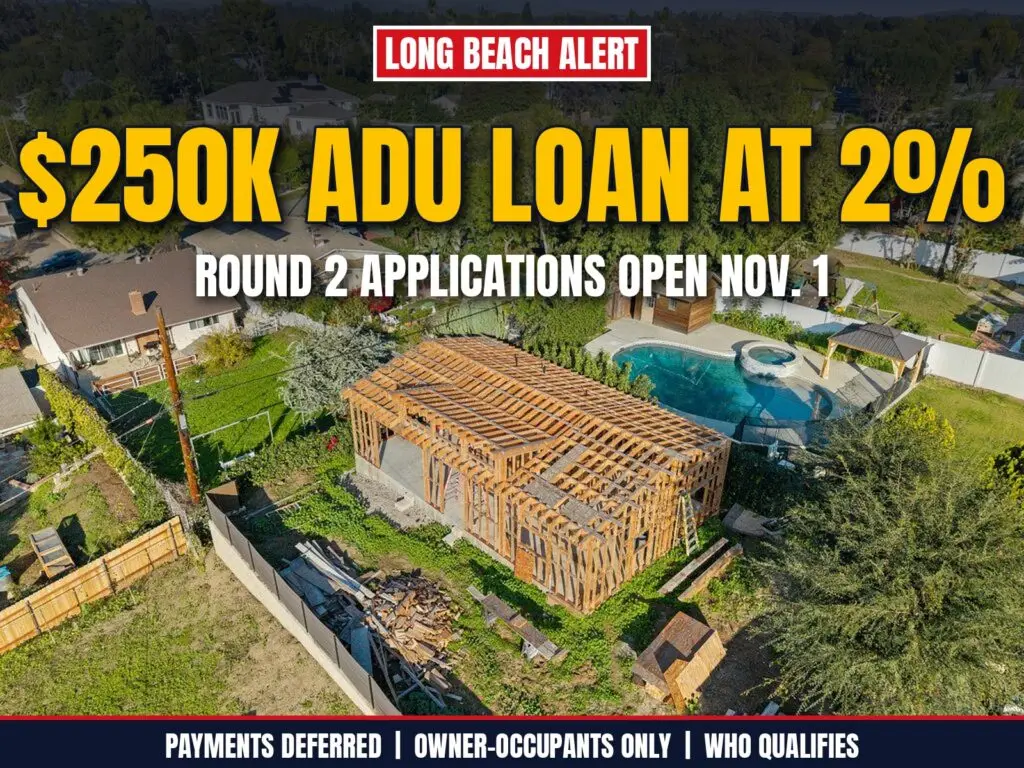
I compared all three on a $250K build in How to Finance an ADU in 2026: Cash vs. HELOC vs. ADU Construction Loan.
7. Knowing Which Cities Work for ADUs
Typical agent: Searches wherever you tell them to.
ADU realtor: Knows that state law sets the rules but cities control permit speed, fees, and whether pre-approved plans exist. A six-month permit delay is six months of carrying costs with no rent. How I think about it:
- Garden Grove: relatively affordable entry prices and the city’s ADU program with pre-approved plans. Here’s a full $1.05M Garden Grove buy-and-build with every number.
- Costa Mesa: strong rents and deep sales data. Short-term rentals are banned, so underwrite for long-term tenants.
- Anaheim, Santa Ana, Westminster, Long Beach: active ADU markets with enough sales to underwrite a deal.
- Cypress, Buena Park, Fullerton: good deals exist, but there’s less sales data to back up your numbers, so I’m more conservative on price.
8. Keeping Up With ADU Law
Typical agent: Hears about big law changes after the fact, if at all.
ADU realtor: Tracks them, because California ADU law changes almost every year. A rule that blocked your plan in 2024 may not apply now. What I’m following:
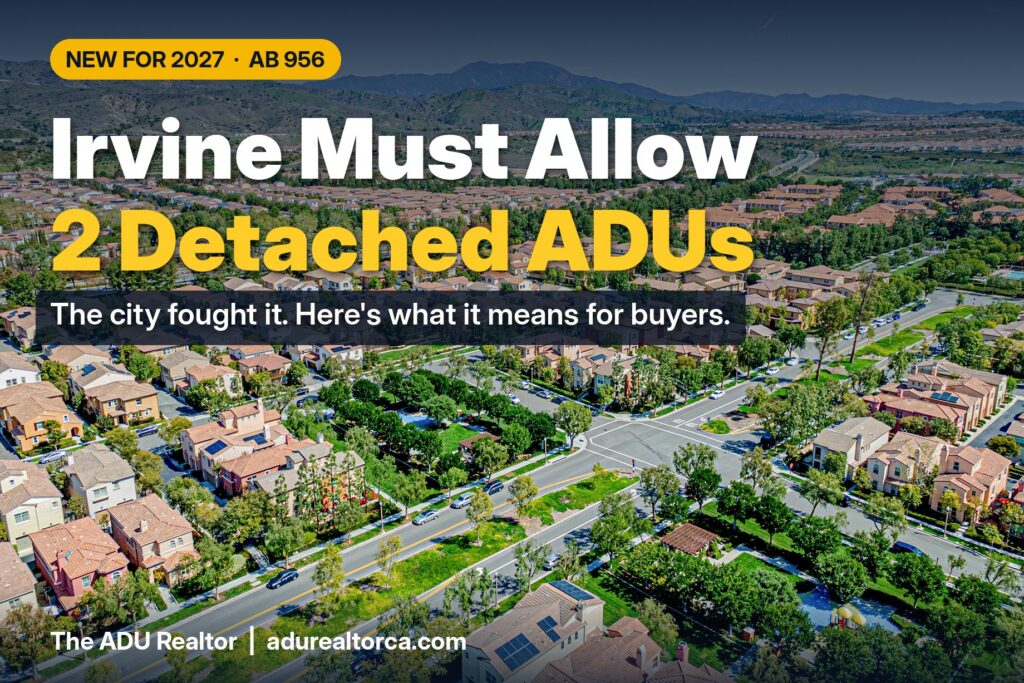
- AB 956 and SB 1117: more detached ADUs allowed on a single-family lot, and the 750 square foot impact fee cliff is gone. Both are covered in Newsom just doubled your ADU count and cut fees on bigger units.
- SB 1196: targets utility hookup delays, one of the most common hidden holdups on ADU projects.
- SB 9: still in effect for most single-family lots in OC and LA. Here’s where SB 9 stands in 2026.
For the official statewide rules, the HCD ADU Handbook (updated March 2026) is the source I point clients to.
9. Planning for Rent Control
Typical agent: Often doesn’t bring it up, or assumes rent control only applies to apartments.
ADU realtor: Explains how California’s statewide rent cap (AB 1482) can affect your long-term income. Newer housing has an exemption, so a newly built ADU is often exempt for a period of time. The details depend on the property’s age, ownership, and the notices given to tenants. I walked through it in Is a New ADU Exempt From Rent Control? AB 1482 Rent Caps on ADUs. For a specific property, confirm with a real estate attorney before you set rents.
10. Negotiating With ADU-Specific Data
Typical agent: Negotiates price and repairs off general neighborhood comps.
ADU realtor: Negotiates off the comps that matter: how comparable ADU properties have actually closed, how long this one has sat, and whether it’s already taken price cuts. Right now, buyers have more leverage than they’ve had in a while. I explained why in OC buyers finally have leverage: what 7%+ rates mean for ADU properties this fall. That leverage can show up as a lower price, seller credits for a rate buydown, or a longer contingency period to verify the ADU plan.
When a Typical Agent Is Fine
To be fair: if you’re buying a home to live in with no plans for a second unit, a good local agent will serve you well. A specialist earns their keep when the second unit is part of the return: buying a property with an existing ADU, buying to build one, or planning an SB 9 split. That’s when the 10 areas above decide whether you made a good investment.
Frequently Asked Questions
What is an ADU realtor?
A licensed real estate agent who specializes in properties with accessory dwelling units, or properties where one can be added. Beyond the standard purchase, they help you evaluate the lot, estimate ADU rent, understand financing, and navigate city and state ADU rules.
Does it cost more to hire an ADU realtor?
Not because of the specialty. Agent compensation is negotiable and set in your written agreement, the same as with any agent.
Can any real estate agent sell a home with an ADU?
Yes. Any licensed agent can. The difference is how well they can verify the ADU’s permits, project rent, and explain how the unit affects financing and value.
How do I check if a California real estate agent is licensed?
Use the California DRE public license lookup and search by name or license number.
Can ADU rental income help me qualify for a mortgage?
Under Fannie Mae’s guidelines, yes, on a one-unit primary residence, with ADU rent capped at 30% of your qualifying income. Confirm with your lender.
Ask Me All 10. Book a Call.
Take any of the 10 areas above and ask me about it on a real property, in a real city, at your budget. Bring a listing you’re looking at, or bring nothing and we’ll start from your goals.
Call Dylan Serna, ADU Realtor at 714-860-2868.