If you’re buying a home with room for a parent, an adult kid or future rental income, you’ll see three terms thrown around in listings: in-law suite, JADU and detached ADU. They sound similar. Financially, they’re very different.
The difference shows up in three places that matter to an investor: what it costs to build, whether a lender will count the rent, and what it does to resale value. Pick the wrong one and you can spend six figures on space that never shows up on your loan application or your appraisal.
You’re not alone in planning for this. According to the National Association of Realtors’ 2026 Generational Trends report, 14% of buyers purchased a multigenerational home, and that share rises to 19% for Gen X buyers. Caring for aging parents and cost savings are the top reasons.
Here’s how the three options compare, and which one fits your plan.
The Quick Comparison
| In-Law Suite | JADU | Detached ADU | |
|---|---|---|---|
| What it is | Extra bedroom/bath area inside the main home | A unit carved out of the existing home | A separate, standalone home on the lot |
| Max size | No set limit (it’s part of the house) | 500 sq ft | Typically up to 1,200 sq ft (local rules vary) |
| Typical layout | Bedroom + bath, maybe a sitting room | Studio or 1-bedroom | Studio up to 3-bed, 2-bath |
| Kitchen | Usually none, or a kitchenette | Efficiency kitchen required | Full kitchen |
| Separate legal unit? | No | Yes, but can’t be sold separately | Yes |
| Counts as rental income to qualify? | No | Only if it’s built to the lender’s ADU standard | Yes |
| Budget range | Lowest | Around $150K | Roughly $250K to $360K+ |
| Privacy | Lowest | Medium | Highest |
Option 1: The In-Law Suite
An in-law suite is a bedroom and bathroom area inside the main house, often with its own sitting area and sometimes a kitchenette or a side door. The key point is that it is part of the main home, not a separate dwelling unit.
That matters for financing. Lenders only count rental income from a legal, separate unit. Fannie Mae’s guidelines say a unit doesn’t qualify as an ADU if it can only be reached through the main home or has no expectation of privacy, and it must have its own bathroom and a kitchen with a real stove or stove hookup (Fannie Mae Selling Guide B2-3-04). Most in-law suites don’t meet that bar.
Bottom line: an in-law suite does not give you the added qualifying income bonus. It’s living space, not an income unit.
Pros
- Lowest cost. You’re often finishing or reconfiguring space, not building a second home.
- No deed restriction or unit rules. It’s just part of your house.
- Easiest for caregiving. A parent is steps away, with no outdoor walk between units.
- Adds bedroom and bathroom count, which appraisers do value as part of the main home.
Cons
- No rental income to help you qualify for a bigger loan.
- No legal second unit to rent when the family member moves on. You can rent a room, but you can’t market it as a separate home.
- Least privacy for both households.
- Unpermitted kitchenettes are a red flag. If you’re buying a home with an “in-law suite” that has a second kitchen added without permits, that can create problems later. Here’s the unpermitted addition problem nobody warns you about.
Best for: Buyers who want a parent close by, have no plans to rent the space and don’t need extra qualifying income.
Option 2: The JADU (Junior ADU)
A Junior Accessory Dwelling Unit is a unit created within the walls of the existing home, including an attached garage, capped at 500 square feet. Think studio or a compact 1-bedroom. Under California Government Code Section 66333, a JADU must have:
- A separate entrance from the main entrance of the house
- An efficiency kitchen with cooking appliances, a prep counter and storage cabinets
- Either its own bathroom or shared access to the main home’s bathroom
A few rules to know before you buy:
- One JADU per single-family lot, and it can’t be sold separately from the house (a deed restriction is recorded).
- Owner occupancy applies if the JADU shares a bathroom with the main house. You’d live in either the main home or the JADU. If the JADU has its own bathroom, that requirement goes away.
- Rentals must be longer than 30 days, so no Airbnb.
- JADUs are only allowed on single-family lots, not on duplexes or apartments. Here’s why you can’t build a JADU on a multifamily property.
The full state rules are in the California HCD ADU Handbook.
Will a JADU count toward your mortgage qualifying income? It can, but only if it’s built to the lender’s ADU standard. That means its own bathroom, its own entrance and a kitchen with a real stove or stove hookup, not a hot plate. A JADU that shares the main bathroom generally won’t count. If income is part of your plan, design it with a private bathroom from day one.
Pros
- Lower-cost ADU. A JADU can often be done for around $150K, because you’re converting space that already has a roof, foundation and utilities.
- Faster than a detached build. Less site work, less new construction.
- A real, separate unit with its own entrance and kitchen, so a parent has independence.
- Can be rented later as a long-term rental once the family member moves on.
- Can be combined with a detached ADU on the same lot, so you can start with a JADU and add more later.
Cons
- 500 sq ft max. It works for one or two people, not a family.
- You give up space in the main house. That spare bedroom or garage is gone.
- Lower rent than a detached unit, because studios and 1-bedrooms rent for less. See what ADUs rent for in Orange County by square footage.
- Shared walls mean less privacy than a detached unit.
- Owner occupancy rule if the bathroom is shared.
Best for: Buyers who want a parent or adult child to have their own space on a tighter budget, and want the option to rent it later.
Want to see this kind of conversion in a real deal? Here’s how a parent’s gift and a garage conversion made a $1.1M Huntington Beach home affordable.
Option 3: The Detached ADU
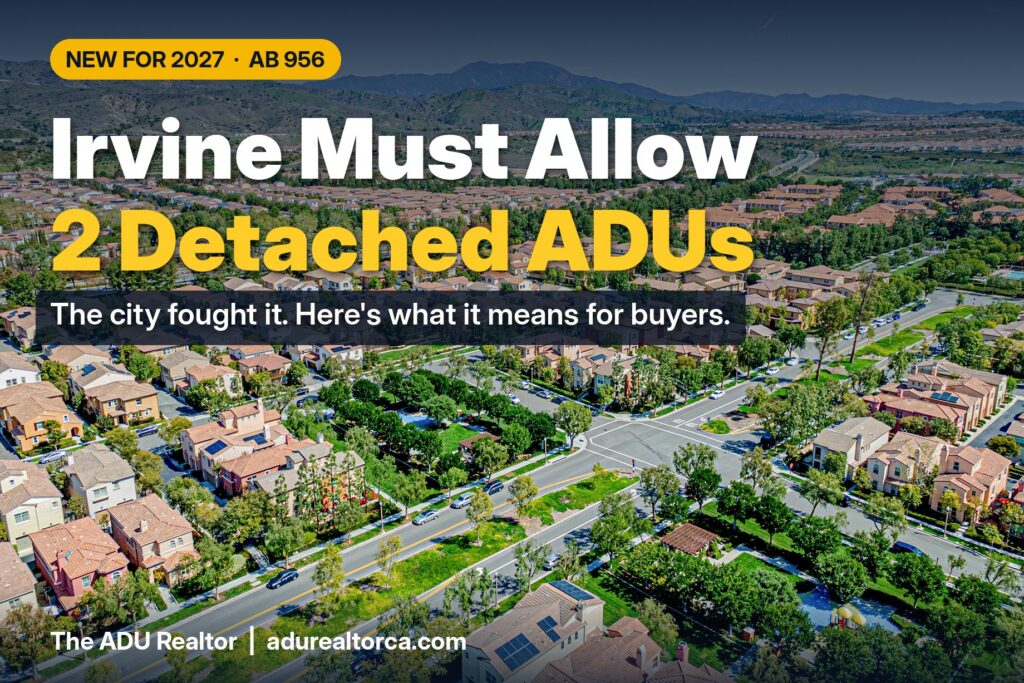
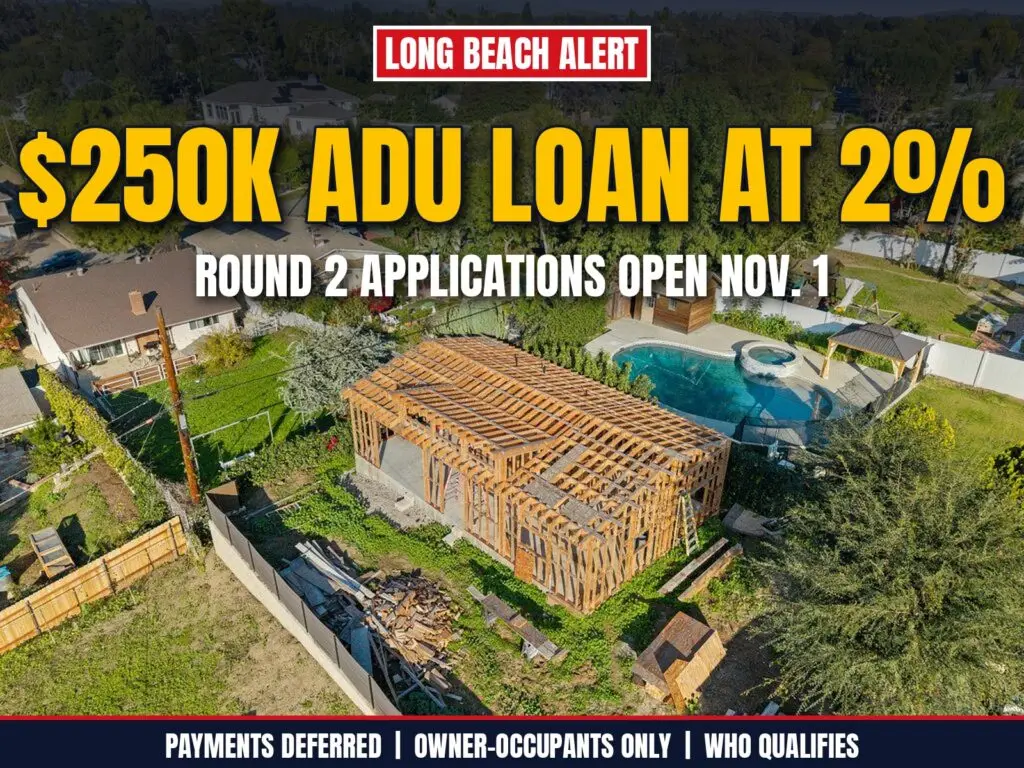
A detached ADU is a separate, standalone home in the backyard with its own kitchen, bathroom(s), entrance and often its own address. In most Orange County and LA cities, detached ADUs can go up to around 1,200 square feet, enough for a 2-bed or 3-bed unit. Thanks to AB 956, many single-family lots can now fit two detached ADUs.
This is the option that works hardest as an investment.
It counts as qualifying income. Fannie Mae’s Desktop Underwriter 12.1 update allows ADU rental income on one-unit primary residences, capped at 30% of total qualifying income. FHA allows it too under HUD Mortgagee Letter 2023-17, counting 75% of the ADU’s market rent.
Here’s a simple example of what that does:
| Amount | |
|---|---|
| Household gross monthly income | $15,000 |
| Detached ADU market rent (example) | $3,000 |
| Counted at 75% | $2,250 |
| Total qualifying income | $17,250 |
| ADU share of income | 13% (under the 30% cap) |
That extra $2,250 a month can raise your purchase price ceiling meaningfully. I ran the full numbers in How Much More House Does an ADU Let You Qualify For?
Pros
- Highest rent and highest value add. A 2-bed or 3-bed unit rents for far more than a studio.
- Counts toward mortgage qualifying income if it’s permitted.
- Most privacy for both households, which matters when Mom and Dad want their own front door.
- Most flexible long term. Parents today, a rental tomorrow, an adult kid after that.
- Single-story design works for aging in place, with no stairs, wide doorways and accessible bathrooms.
Cons
- Highest cost. Expect roughly $250K to $360K+ depending on size and finish. Here’s how a $360K 3-bed, 2-bath ADU construction loan works.
- Longer timeline. Plans, permits and construction can take 9 to 18 months.
- Needs the right lot. Lot size, setbacks, utility access and yard layout all matter. See the best ADU layout for a 6,000 vs. 9,000 sq ft lot.
- Uses up yard space.
Best for: Buyers who want the strongest long-term investment, the most privacy for a parent, and rent that helps them qualify for more home.
Which One Fits Your Plan?
Ask yourself three questions:
1. Do you need the rent to qualify for the home you want?
If yes, you need a permitted unit that meets the lender’s ADU standard. That means a detached ADU, or a JADU built with its own bathroom and a real kitchen. An in-law suite won’t help.
2. What’s your budget for the unit?
- Under $150K: an in-law suite
- Around $150K: a JADU
- $250K and up: a detached ADU
3. What happens in 10 years?
If a parent lives there now but you’ll want rental income later, build a legal unit. An in-law suite can’t become a legal rental without more work. A JADU or a detached ADU can. And if a detached ADU is newly built, check whether it qualifies for an exemption from AB 1482 rent caps.
For most of my multigenerational buyers, the decision comes down to this: a JADU if the budget is tight and the household is small, a detached ADU if the numbers support it. The detached unit costs more up front, but it’s the only option that gives you full privacy, the highest rent and the biggest boost to qualifying income.
Frequently Asked Questions
Is an in-law suite the same as an ADU?
No. An in-law suite is part of the main home. An ADU is a separate legal dwelling unit with its own entrance, kitchen and bathroom. Lenders and appraisers treat them differently.
Can I use rent from an in-law suite to qualify for a mortgage?
Generally no. Lenders only count rental income from a legal, separate unit that meets their ADU standard.
How big can a JADU be in California?
Up to 500 square feet, built within the walls of the existing home or attached garage.
Do I have to live on the property if I build a JADU?
Only if the JADU shares a bathroom with the main house. If it has its own bathroom, the owner occupancy requirement doesn’t apply.
Can I have a JADU and a detached ADU on the same lot?
Yes, on many single-family lots in California you can have both. Check your city’s rules for exact limits.
What’s the cheapest way to add a unit for my parents?
A JADU is usually the lowest-cost legal unit, often around $150K. An in-law suite can cost less, but it won’t be a separate rentable unit.
Planning a Home for More Than One Generation?
Whether you’re buying a home with a unit already built or a lot where you can add one, I’ll help you figure out which option fits your family and your numbers.
Call Dylan Serna, ADU Realtor at 714-860-2868.